CHICHESTER PSALMS

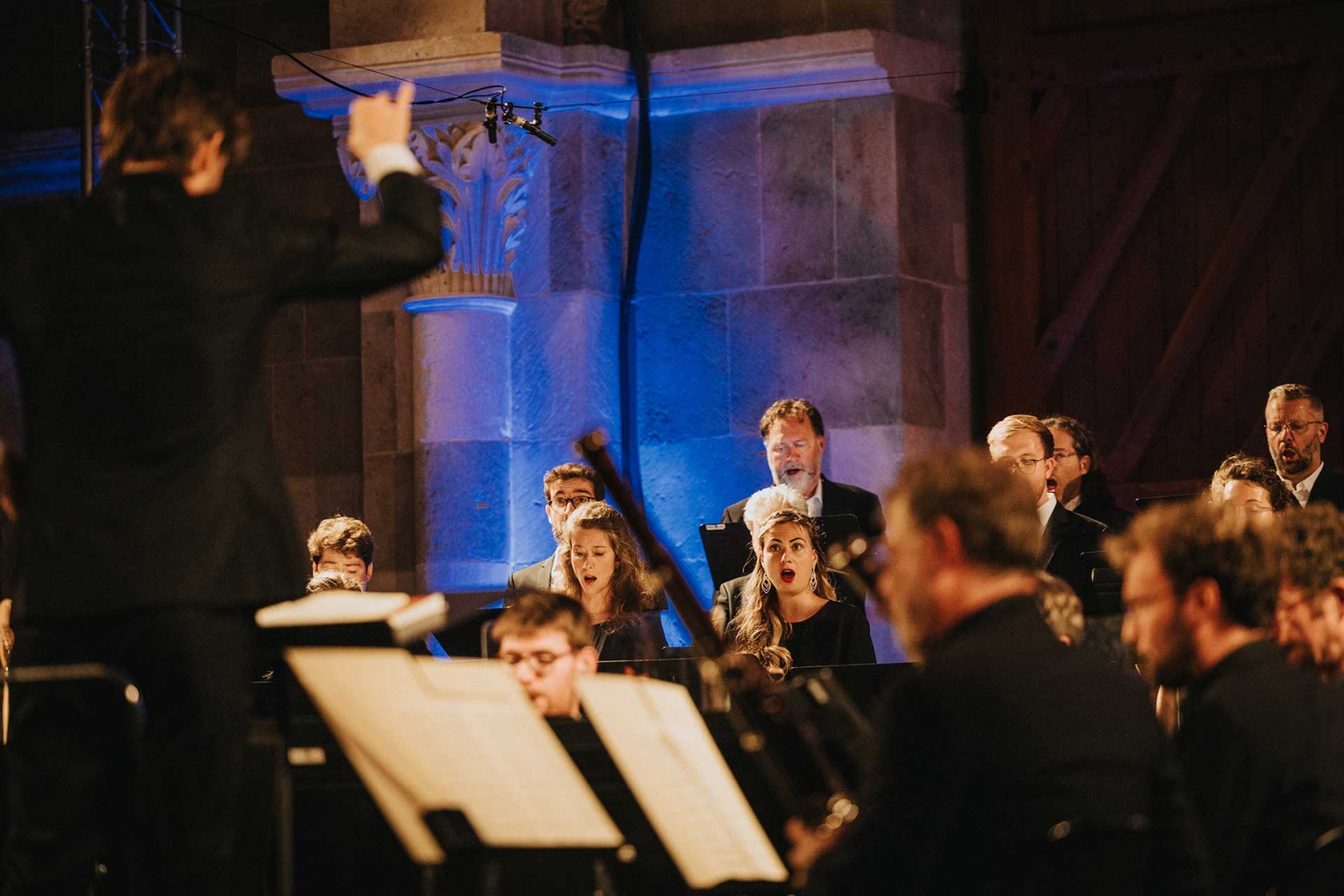
From Francis Poulenc to Leonard Bernstein, via Arvo Pärt and Julia Wolfe, this program charts a spiritual journey marked by contemplation, inner tension, and shared enthusiasm. Beneath the vaults of Vézelay, Les Métaboles and the Metz Grand Est National Orchestra, conducted by Léo Warynski, weave a sensitive dialogue between silence, prayer, and choral energy. Bernstein’s Chichester Psalms bring the evening to a close in a radiant celebration, where singing becomes a collective gesture and a space for fellowship. 

CHICHESTER PSALMS


Francis Poulenc
Litanies à la Vierge noire 

Arvo Pärt
Te Deum

Julia Wolfe 
Guard my tongue 

Leonard Bernstein
Chichester Psalms 


Les Métaboles
Orchestre national de Metz Grand Est
Avec la participation de Africa Lyric Choir
Léo Warynski, direction


Coproduction Les Métaboles, Cité de la Voix et la Cité musicale-Metz.
La Fondation Orange supports the participation of Africa Lyric Choir in this program.
This concert is supported by Madame Michèle Nussbaumer, the main patron of the ensemble.

Dans la presse

"Integrity, simplicity, and a focus on the text guide the performance under Léo Warynski’s extremely understated and precise direction."

Forum Opéra – Tania Bracq - Chichester Psalms

"While its artistic director, François Delagoutte, has announced his departure—prompting heartfelt tributes—Les Métaboles’ residency at the Cité de la Voix has just been renewed for three years. It is therefore only natural that the Saturday evening concert of the Rencontres Musicales de Vézelay has been entrusted to them, featuring a demanding program, created especially for the occasion, full of grace and simplicity.

From the very opening of Poulenc’s *Litanies à la Vierge noire*, the women’s voices—crystal clear—rise in an a cappella passage that immediately captivates: “Lord, have mercy.” Simplicity defines the interpretation of this work, with understated phrasing that follows the sinuous contours of the vocal line. […]

Throughout the concert, the choir deliberately limits its use of color, seeking a timbre that might be described as ecclesiastical—rather bright, almost youthful—which underscores the sincerity of the invocation. This in no way precludes the interplay of textures, in which the men’s voices shine brilliantly in “Tu es le fils éternel du père / Tu patris sempiternus es Filius.” Nor does it preclude the beautiful nuances from piano to forte that punctuate the text like so many stations along a path of faith. What could be more fitting for this work, which represents the Estonian musician’s (re)discovery of the Creed—music “of the origins” composed after eight years of studying Gregorian chant? This Gregorian precision permeates the entire performance, in which there is no affectation, no ostentatious coquetry. Integrity, simplicity, and service to the text guide the performance under Léo Warynski’s extremely sober and precise direction: what we are offered here is music stripped to its very essence, with voices treated instrumentally to create a sonic immersion that is itself an expression of mercy." 

"With ideal accompaniment, the Les Métaboles choir delivers a performance full of delicacy and harmony."

Olyrix – Lara Aymen de Lageard
 - Chichester Psalms

"With ideal accompaniment, the Les Métaboles choir delivers a performance full of delicacy and harmony."

Olyrix – Lara Aymen de Lageard - Chichester Psalms
Earth-Shattering Performances at the Rencontres Musicales de Vézelay with Les Métaboles

On the final night of the 2026 edition of the Rencontres Musicales de Vézelay, Les Métaboles chart a spiritual journey through the contemporary repertoire. Léo Warynski conducts the Metz Grand Est National Orchestra, Les Métaboles, and—for the first time—the Africa Lyric Choir.

Léo Warynski certainly never lacks ambition when it comes to his concerts at the Basilica of Vézelay. Following last year’s edition, which featured a program dedicated to Philip Glass titled “Another Look at Harmony”—in which he promised to “transform the basilica into a spaceship”— at the start of this concert, earplugs were handed out to the audience—a sign of a sound so powerful it could make the building’s walls tremble!

[…] With such ideal support, the Les Métaboles choir delivers a performance marked by delicacy and harmony. The unity within each vocal range—which blends seamlessly—allows the audience to appreciate both the shimmering radiance of the sopranos and the solemn power of the basses. This gives rise to moments of suspended beauty, such as the final “Sanctus” of the Te Deum and this plea for God’s mercy.

The Africa Lyric Choir, collaborating for the first time with Les Métaboles, presents stark contrasts, with long, deep, dark, and prominent bass lines. The dynamics are very clear, bouncy, and marked by a rhythmic precision that meets the demands of “Guard My Tongue” and, above all, the “Chichester Psalms” that follow. Here, earplugs are indeed welcome, as the extraordinary power of the sound is enough to make the floor vibrate!

In an ideal setting—directly in line with the choir—the perfect symmetry of Léo Warynski’s geometric compositional structure, with its clean lines, is crafted with meticulous care and precision, revealing, section by section and with exemplary clarity, the architecture of each work. This allows one to appreciate not only its structure but also the finesse with which it is executed. Combining minimalism with grandeur, he guides the musicians with meticulousness and sensitivity toward a moment of rare intensity. This is the very embodiment of top-tier conducting. [...]”

"The singing moves away from all aesthetic mannerism to achieve a kind of poignant, disembodied purity."

Bachtrack – Pierre Michel - Chichester Psalms
Les Métaboles and Aedes Shine at the Rencontres musicales de Vézelay

“[…] On Saturday evening, Les Métaboles presented a program structured as a contemplative progression under the direction of their conductor, Léo Warynski. Following Poulenc’s Litanies à la Vierge noire, during which the women’s sections distinguished themselves through their ability to convey a full spectrum of lamentations—from tearful resignation to desperate incomprehension—the choir evolved its vocal delivery, seeking a kind of primal song in Arvo Pärt’s Te Deum. The singing moves away from any aesthetic mannerism to achieve a kind of poignant, disembodied purity. For its part, the Metz Grand Est National Orchestra plays its schizophrenic role to perfection in both works, oscillating between static soundscapes and haunting rhythmic motifs, with stormy timpani in Poulenc’s piece.

Following the breathing passages in Julia Wolfe’s Guard My Tongue, in which Les Métaboles a cappella demonstrate remarkable cohesion, the ensemble is joined by the Africa Lyric Choir for Bernstein’s Chichester Psalms. The explosive energy of the first movement shatters the pure spiritual elevation achieved up to that point, infusing it with joy – like a sense of liberation. The precision of the orchestra’s percussion and brass attacks helps maintain a semblance of structure in this passage, which pushes the nave’s acoustic limits. After a soaring second movement featuring a magnificent solo by countertenor Julien Freymuth – who skillfully exploits the basilica’s resonances – the fusion of the two choirs elevates the irresistible hymnal formula of the finale."

“Solemn and peaceful, profound without ever veering into grandiloquence, austere yet strangely captivating, this Te Deum will also remain in the minds and hearts of the Vézelay audience.”

La Croix – Emmanuelle Giuliani - Chichester Psalms
Vézelay Musical Encounters: From Poulenc to Bernstein, a Spiritual Journey

Filling the basilica with their waves of sound and rhythm, Leonard Bernstein’s Chichester Psalms brought to a close, on Saturday, August 22, a magnificent choral program conceived by Léo Warynski.

“I often put together my concert programs by starting with a single work that I then pair with other scores, playing on correspondences, affinities, and contrasts,” explains conductor Léo Warynski. […]

All the more so as the singers of Les Métaboles, joined by those of the Africa Lyric Choir and the Metz National Orchestra, vied with one another in passion, fervor, and delicacy.

The harps, evoking that of King David, lend a celestial and biblical dimension, as do the lyrics sung in Hebrew, ranging from majestic outbursts to praise of God and spiritual introspection.

Performed in one continuous set, the concert opened with a splendid, contemplative, and tender rendition of Francis Poulenc’s Litanies à la Vierge noire. Sung by a women’s choir, the piece invokes and honors—as its title suggests—the Black Madonna of Rocamadour, who inspired Poulenc’s return to the Catholic faith of his childhood. A challenging piece to perform—as it demands simplicity as well as precision and elegance in diction and intonation—the score suits the singers of Les Métaboles perfectly, with their crystal-clear yet full-bodied timbres. Another admirable piece is Arvo Pärt’s Te Deum, premiered in 1985. Three choirs, a prepared piano, a string orchestra, and the sound of Aeolian harps recorded on magnetic tape: the musical forces are substantial, yet the overall texture is surprisingly transparent and airy, from the deepest tones to the soaring passages toward mystical heights. Enchanting, even hypnotic, and admirably structured, the work rises in layers of strings to which the voices respond with passages reminiscent of Gregorian chant.

Solemn and peaceful, profound without ever veering into grandiloquence, austere yet strangely alluring, this Te Deum will also remain in the minds and hearts of the Vézelay audience. […]”

2026

August

Saturday, August 22 2026 - 9:00 pmChichester PsalmsRencontres musicales de Vézelay

From Francis Poulenc to Leonard Bernstein, via Arvo Pärt and Julia Wolfe, this program charts a spiritual journey marked by contemplation, inner tension, and shared momentum.

Beneath the vaults of Vézelay, Les Métaboles and the Orchestre national de Metz Grand Est, conducted by Léo Warynski, weave a sensitive dialogue between silence, prayer, and choral energy. Bernstein’s Chichester Psalms bring the evening to a close in a luminous jubilation, where singing becomes a collective gesture and a space of brotherhood.

Reservations