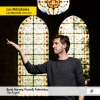
THE ANGELS

It was only a few months before his death that Jonathan Harvey completed his final work, The Plain Songs for Peace and Light - thus testifying, despite a constant commitment to the most futuristic technology, to a fidelity to a cappella vocal writing, to which he always returned. Speaking of I love the Lord, written 36 years earlier, he already evokes the deep imprint left on him by listening to the choral liturgy, week after week.

Around Harvey, it is indeed the splendid tradition of English choirs that this concert brings to life. From Winchester to the refectory of the monks of Royaumont, the Gothic walls of the abbeys resound with polyphonic music, sumptuous and magnified by the acoustics. The dialogue of the texts responds to the sound echoes: In The Annunciation, Harvey takes up entirely the first stanza of Palestrina's Stabat Mater, whose text sublimates the pain of the mother of Jesus - thus completing the cycle of the birth and death of Christ as seen by her. To the humility and anguish of the penitent, expressed by the painful dissonances of Byrd's Ave verum, responds the serenity of the believer, which Harvey expresses through the stability of a perfect chord. Harvey’s and Purcell’s symmetrical Remember also calls for the reactivation of the prodigious sound memories that continue to haunt Anglican cathedrals.

Co-production : La Fondation Royaumont (as part of the Métaboles 2019-2021 residency) and La Fondation Bettencourt-Schueller

THE ANGELS


William Byrd 
Ave verum 

Benjamin Britten 
A Hymn to the Virgin

Jonathan Harvey
I love the Lord, pour double chœur a cappella
Come Holy Ghost, pour chœur a cappella
Plain Songs for Peace and Light, pour chœur a cappella

Henry Purcell 
Remember not Lord, our offenses 

Jonathan Harvey 
Remember, O Lord

John Tavener 
The Lamb

Giovanni Pierluigi da Palestrina 
Stabat Mater pour double chœur 

Jonathan Harvey
The annunciation
The Angels pour double chœur a cappella 


Les Métaboles (16 singers)
Léo Warynski, direction


Dans la presse

So many angels came this day

ConcertClassic - Laurent Bury
 - The Angels

So many angels came this day

ConcertClassic - Laurent Bury - The Angels

Métaboles concert at the Musée d'Orsay - So many angels came today - Review

To open its 2023-24 season, the Auditorium of the Musée d'Orsay is offering a midday concert linked to one of its exhibitions, as is customary. To celebrate Louis Janmot (1814-1892), the very mystical painter from Lyon to whom a retrospective is currently devoted, it was logical to propose a religious program, and as his canvases are literally teeming with angels, the ensemble Les Métaboles came interpret the content of his disc The Angels recorded in 2019 and released in 2021. But as the CD lasts barely three-quarters of an hour, a few pieces were added to reach the usual duration of concerts at the Musée d'Orsay.

In relation to the disc, three composers therefore make their entry: Britten, his compatriot John Tavener (1944-2013) and the Estonian Arvo Pärt, the only one still alive. However, the language of Shakespeare remains dominant, Pärt having set to music the modern English translation of an old Gaelic prayer. This reinforcement of works from the 20th and 21st centuries has the effect of isolating a little more the works of Byrd, Purcell and especially Palestrina, the latter's Stabat Mater belonging decidedly to a completely different aesthetic universe, while the two British artists of the 17th century are easier to relate to Jonathan Harvey (1939-2012) who dominates the program. The exhibition notably brings William Blake closer to Janmot, both having been painters and poets, the presence of Blake's poem "The Lamb" set to music by Tavener is thus justified. A Hymn to the Virgin by a sixteen-year-old Britten hardly allows us to detect the strong musical personality that would assert itself a few years later.

In other words, even if it is The Deer’s Cry by Arvo Pärt that Les Métaboles will cover as an encore at the end of the concert, Jonathan Harvey remains the undisputed king of this program. His works prove to anyone who doubts that it is still possible in our time to compose music of religious inspiration which is absolutely not outdated. “Come Holy Ghost” begins by taking up the Gregorian melody of Veni creator, but this is to better distort it, to diffract it between the sixteen voices which form the whole. Harvey tackled liturgical texts as well as modern poems, with always astonishing and beautiful results. Léo Warynski guides his troops with a sure hand through the twists and turns of these scores, and can count on the members of the choir to change into soloists at will when the music requires it, with in the first place the very recognizable timbre of the soprano Anne-Claire Baconnais to name but one.

The Musée d'Orsay thus gives a superb start to a musical season placed under the sign of spirituality, in relation to The Poem of the Soul by Louis Janmot.

So many angels came this day

ConcertClassic - Laurent Bury
 - The Angels

So many angels came this day

ConcertClassic - Laurent Bury - The Angels

Métaboles concert at the Musée d'Orsay - So many angels came today - Review

To open its 2023-24 season, the Auditorium of the Musée d'Orsay is offering a midday concert linked to one of its exhibitions, as is customary. To celebrate Louis Janmot (1814-1892), the very mystical painter from Lyon to whom a retrospective is currently devoted, it was logical to propose a religious program, and as his canvases are literally teeming with angels, the ensemble Les Métaboles came interpret the content of his disc The Angels recorded in 2019 and released in 2021. But as the CD lasts barely three-quarters of an hour, a few pieces were added to reach the usual duration of concerts at the Musée d'Orsay.

In relation to the disc, three composers therefore make their entry: Britten, his compatriot John Tavener (1944-2013) and the Estonian Arvo Pärt, the only one still alive. However, the language of Shakespeare remains dominant, Pärt having set to music the modern English translation of an old Gaelic prayer. This reinforcement of works from the 20th and 21st centuries has the effect of isolating a little more the works of Byrd, Purcell and especially Palestrina, the latter's Stabat Mater belonging decidedly to a completely different aesthetic universe, while the two British artists of the 17th century are easier to relate to Jonathan Harvey (1939-2012) who dominates the program. The exhibition notably brings William Blake closer to Janmot, both having been painters and poets, the presence of Blake's poem "The Lamb" set to music by Tavener is thus justified. A Hymn to the Virgin by a sixteen-year-old Britten hardly allows us to detect the strong musical personality that would assert itself a few years later.

In other words, even if it is The Deer’s Cry by Arvo Pärt that Les Métaboles will cover as an encore at the end of the concert, Jonathan Harvey remains the undisputed king of this program. His works prove to anyone who doubts that it is still possible in our time to compose music of religious inspiration which is absolutely not outdated. “Come Holy Ghost” begins by taking up the Gregorian melody of Veni creator, but this is to better distort it, to diffract it between the sixteen voices which form the whole. Harvey tackled liturgical texts as well as modern poems, with always astonishing and beautiful results. Léo Warynski guides his troops with a sure hand through the twists and turns of these scores, and can count on the members of the choir to change into soloists at will when the music requires it, with in the first place the very recognizable timbre of the soprano Anne-Claire Baconnais to name but one.

The Musée d'Orsay thus gives a superb start to a musical season placed under the sign of spirituality, in relation to The Poem of the Soul by Louis Janmot.

The Metaboles hold the angels above the Musée d’Orsay

Resmusica - Patrick Jézéquel
 - The Angels

The Metaboles hold the angels above the Musée d’Orsay

Resmusica - Patrick Jézéquel - The Angels


The Metaboles hold the angels above the Musée d’Orsay

For the first concert of its season, the auditorium of the Musée d'Orsay invites the Métaboles in a recital of sacred song, "The Angels", resonating with the concomitant exhibition dedicated to Louis Janmot (1814-1892) and entitled : “The Poem of the Soul.”

We knew Les Métaboles were at ease when, with all voices out (nearly 50 in total), they filled the volume of a nave (in this case that of the Vézelay basilica). Here they are in a much smaller space - that of the auditorium of the Musée d'Orsay -, with quiet and fairly dry acoustics, which perfectly suits their squad: sixteen singers. Or even much less, when, at the very beginning, four of them intone the Ave verum corpus (1605) by William Byrd, placed behind the audience, at the back of the room. The effect is striking, especially since we expected to hear their comrades on stage. The Catholic liturgy envelops us in this intimate motet, very slow and very collected. So, today, time for clarity, intensity and conviviality!

The program is based on that of the disc The Angels (NoMadMusic, 2021, Clef d'or ResMusica) augmented by three songs by Benjamin Britten (A Hymn to the Virgin, 1930), John Taverner (The Lamb, 1982) and Arvo Pärt (The Deer's Cry, 2008). Composers from the Renaissance (Byrd, Purcell, Palestrina) and others from the 20th and 21st centuries (Harvey, Britten, Pärt, Taverner), all pious and custodians of a musical culture that they transformed. Twelve songs in all, the combination of which plays on the double picture of polyphonic clarity and a certain contemporary expressiveness (for example, The Deer's Cry by Arvo Pärt, obsessive and sober – two trademarks of this creator – and which will be given again as an encore). Always with this concern to put man, that is to say the believer, at the center, therefore man alone addressing his god, hence the importance given to the text and the exclusivity to the naked voice. It is all the aesthetic interest of a choir reduced to its minimum, which ensures the intelligibility of the song in its different layers. This can be heard more particularly in Come, Holy Ghost (1984) and Plainsongs for Peace and Light (2012) by Jonathan Harvey (1939-2012), which both take up the simplicity of expression of plainsong, which we could be described as a novel. Harvey is also the most present composer this afternoon, with six pieces, surely the most astonishing too, characterized by an incredible refinement, which produces: the mystical character of his inspiration with his personal dimension, an instability maintained between worry and peace (which contrasts strongly with, in particular, the architectural solidity of the Stabat Mater [1580] by Giovanni Pierluigi da Palestrina), swirling harmonies, variations between melisma and syllabic singing, the extreme layering of registers based on chords in drone, or the clever tiling of voices as well as the surprising descending glissandi at the end of Come, Holy Ghost. All these effects are wonderfully rendered by an ensemble attentive to the flexible inflections of the conductor.

Very finely thought out, the sequence of pieces follows several concerns. First, keep the attention of listeners by alternating songs of different characters or levels of complexity. Thus the Ave Verum corpus by William Byrd and Remember not, Lord, our offenses (1681) by Henry Purcell frame A Hymn to the Virgin by Benjamin Britten and three songs by Harvey: I love the Lord (1976), Come Holy Ghost and Plainsongs for Peace and Light. Second, preserve a certain variety, in a stable context, through the regular distribution of solos. We will remember, in Byrd's Ave Verum corpus and Harvey's The Annunciation (2011), the powerful soprano Anne-Claire Baconnais, the alto Aurélie Bouglé as well as the bass Jeroen Bredewold, and, in Come, Holy Ghost, the sublime soprano Amandine Trenc and tenor Benjamin Aguirre Zubiri, whose songs literally fly out of the frame. Third, make a sort of intellectual or cultural nod by following Purcell's Remember not, Lord, our offenses and Harvey's Remember, O Lord (2003), a way of emphasizing an inspiration and a filiation.

The public was able to commune with extremely nuanced singers led by their leader, Léo Warynski, visibly grateful to his musicians and very happy to be among us.


The Metaboles hold the angels above the Musée d’Orsay

Resmusica - Patrick Jézéquel
 - The Angels

The Metaboles hold the angels above the Musée d’Orsay

Resmusica - Patrick Jézéquel - The Angels


The Metaboles hold the angels above the Musée d’Orsay

For the first concert of its season, the auditorium of the Musée d'Orsay invites the Métaboles in a recital of sacred song, "The Angels", resonating with the concomitant exhibition dedicated to Louis Janmot (1814-1892) and entitled : “The Poem of the Soul.”

We knew Les Métaboles were at ease when, with all voices out (nearly 50 in total), they filled the volume of a nave (in this case that of the Vézelay basilica). Here they are in a much smaller space - that of the auditorium of the Musée d'Orsay -, with quiet and fairly dry acoustics, which perfectly suits their squad: sixteen singers. Or even much less, when, at the very beginning, four of them intone the Ave verum corpus (1605) by William Byrd, placed behind the audience, at the back of the room. The effect is striking, especially since we expected to hear their comrades on stage. The Catholic liturgy envelops us in this intimate motet, very slow and very collected. So, today, time for clarity, intensity and conviviality!

The program is based on that of the disc The Angels (NoMadMusic, 2021, Clef d'or ResMusica) augmented by three songs by Benjamin Britten (A Hymn to the Virgin, 1930), John Taverner (The Lamb, 1982) and Arvo Pärt (The Deer's Cry, 2008). Composers from the Renaissance (Byrd, Purcell, Palestrina) and others from the 20th and 21st centuries (Harvey, Britten, Pärt, Taverner), all pious and custodians of a musical culture that they transformed. Twelve songs in all, the combination of which plays on the double picture of polyphonic clarity and a certain contemporary expressiveness (for example, The Deer's Cry by Arvo Pärt, obsessive and sober – two trademarks of this creator – and which will be given again as an encore). Always with this concern to put man, that is to say the believer, at the center, therefore man alone addressing his god, hence the importance given to the text and the exclusivity to the naked voice. It is all the aesthetic interest of a choir reduced to its minimum, which ensures the intelligibility of the song in its different layers. This can be heard more particularly in Come, Holy Ghost (1984) and Plainsongs for Peace and Light (2012) by Jonathan Harvey (1939-2012), which both take up the simplicity of expression of plainsong, which we could be described as a novel. Harvey is also the most present composer this afternoon, with six pieces, surely the most astonishing too, characterized by an incredible refinement, which produces: the mystical character of his inspiration with his personal dimension, an instability maintained between worry and peace (which contrasts strongly with, in particular, the architectural solidity of the Stabat Mater [1580] by Giovanni Pierluigi da Palestrina), swirling harmonies, variations between melisma and syllabic singing, the extreme layering of registers based on chords in drone, or the clever tiling of voices as well as the surprising descending glissandi at the end of Come, Holy Ghost. All these effects are wonderfully rendered by an ensemble attentive to the flexible inflections of the conductor.

Very finely thought out, the sequence of pieces follows several concerns. First, keep the attention of listeners by alternating songs of different characters or levels of complexity. Thus the Ave Verum corpus by William Byrd and Remember not, Lord, our offenses (1681) by Henry Purcell frame A Hymn to the Virgin by Benjamin Britten and three songs by Harvey: I love the Lord (1976), Come Holy Ghost and Plainsongs for Peace and Light. Second, preserve a certain variety, in a stable context, through the regular distribution of solos. We will remember, in Byrd's Ave Verum corpus and Harvey's The Annunciation (2011), the powerful soprano Anne-Claire Baconnais, the alto Aurélie Bouglé as well as the bass Jeroen Bredewold, and, in Come, Holy Ghost, the sublime soprano Amandine Trenc and tenor Benjamin Aguirre Zubiri, whose songs literally fly out of the frame. Third, make a sort of intellectual or cultural nod by following Purcell's Remember not, Lord, our offenses and Harvey's Remember, O Lord (2003), a way of emphasizing an inspiration and a filiation.

The public was able to commune with extremely nuanced singers led by their leader, Léo Warynski, visibly grateful to his musicians and very happy to be among us.

4 F - In the acoustical setting of the Royaumont Abbey, Les Métaboles bring to life an a cappella repertoire of famous Englishmen, from Henry Purcell to Jonathan Harvey

Télérama - Sophie Bourdais - The Angels - CD

In the acoustical setting of the Royaumont Abbey, Les Métaboles bring to life an a cappella repertoire of famous Englishmen, from Henry Purcell to Jonathan Harvey.

Supple, clear, and warm, the voices of Les Métaboles are just as capable of intervening as soloists and ensuring the clarity of the vocal lines as they are of blending into the choral polyphony. They are marvelous in this agelessly modern repertoire, which plays with a Gregorian plainchant coated in a vocal mist and traversed by turbulence (Plainsongs for Peace and Light), sculpting the sound with bewitching harmonic sequences (I love the Lord), and finally taking us into another dimension (The Angels), with a floating and strangely comforting beauty.

4 F - In the acoustical setting of the Royaumont Abbey, Les Métaboles bring to life an a cappella repertoire of famous Englishmen, from Henry Purcell to Jonathan Harvey

Télérama - Sophie Bourdais - The Angels - CD

In the acoustical setting of the Royaumont Abbey, Les Métaboles bring to life an a cappella repertoire of famous Englishmen, from Henry Purcell to Jonathan Harvey.

Supple, clear, and warm, the voices of Les Métaboles are just as capable of intervening as soloists and ensuring the clarity of the vocal lines as they are of blending into the choral polyphony. They are marvelous in this agelessly modern repertoire, which plays with a Gregorian plainchant coated in a vocal mist and traversed by turbulence (Plainsongs for Peace and Light), sculpting the sound with bewitching harmonic sequences (I love the Lord), and finally taking us into another dimension (The Angels), with a floating and strangely comforting beauty.

5 stars - the perfect intonation of Les Métaboles under the crafted conducting of Léo Warynski

Classica - Jérémie Bigorie
 - The Angels - CD

5 stars - the perfect intonation of Les Métaboles under the crafted conducting of Léo Warynski

Classica - Jérémie Bigorie - The Angels - CD

Recorded within the walls of the monks' refectory at Royaumont Abbey, the entirely a cappella programme combines ancient and contemporary periods. William Byrd's Ave Verum immediately reveals the perfection of Les Métaboles' intonation under the crafted direction of Léo Warynski. A space opens out, starting from the opening quartet of soloists from the pulpit, to the full ensemble. The latter is arranged in a double choir for Palestrina's sublime Stabat Mater, taken at a relatively fast tempo. The result is a choral effusion of great fluidity, of which the quality of execution precludes any precipitation, especially during the exchanges in alla breve values. We find this urgency in Purcell's Remember Not, of which the intensity represents a gesture of desperation. It is echoed in Jonathan Harvey's Remember, to whom the album pays a fine tribute nine years after his passing.

5 stars - the perfect intonation of Les Métaboles under the crafted conducting of Léo Warynski

Classica - Jérémie Bigorie
 - The Angels - CD

5 stars - the perfect intonation of Les Métaboles under the crafted conducting of Léo Warynski

Classica - Jérémie Bigorie - The Angels - CD

Recorded within the walls of the monks' refectory at Royaumont Abbey, the entirely a cappella programme combines ancient and contemporary periods. William Byrd's Ave Verum immediately reveals the perfection of Les Métaboles' intonation under the crafted direction of Léo Warynski. A space opens out, starting from the opening quartet of soloists from the pulpit, to the full ensemble. The latter is arranged in a double choir for Palestrina's sublime Stabat Mater, taken at a relatively fast tempo. The result is a choral effusion of great fluidity, of which the quality of execution precludes any precipitation, especially during the exchanges in alla breve values. We find this urgency in Purcell's Remember Not, of which the intensity represents a gesture of desperation. It is echoed in Jonathan Harvey's Remember, to whom the album pays a fine tribute nine years after his passing.

...singers freed from tension and even more radiant...

Diapason - Pierre Rigaudière
 - The Angels au Festival de Royaumont

...singers freed from tension and even more radiant...

Diapason - Pierre Rigaudière - The Angels au Festival de Royaumont

On this occasion a cappella, Les Métaboles are, with their concert "The Angels", at the heart of the weekend's 'In Flight' theme. We actually take off with a programme concocted by the very efficient Léo Warynski, at the heart of which is the vocal music by Jonathan Harvey and which naturally resonates with Byrd, Palestrina and Purcell.
Unaggressive and marked by a harmonic hedonism that resembles the Scandinavian and Baltic choral vein, Harvey's meditative music reflects his Buddhist inspiration. Performed during the encore by singers freed from tension and even more radiant, the short piece “The Angels” abundantly fills the acoustics of the Monks' Refectory and illuminates the evening.

...singers freed from tension and even more radiant...

Diapason - Pierre Rigaudière
 - The Angels au Festival de Royaumont

...singers freed from tension and even more radiant...

Diapason - Pierre Rigaudière - The Angels au Festival de Royaumont

On this occasion a cappella, Les Métaboles are, with their concert "The Angels", at the heart of the weekend's 'In Flight' theme. We actually take off with a programme concocted by the very efficient Léo Warynski, at the heart of which is the vocal music by Jonathan Harvey and which naturally resonates with Byrd, Palestrina and Purcell.
Unaggressive and marked by a harmonic hedonism that resembles the Scandinavian and Baltic choral vein, Harvey's meditative music reflects his Buddhist inspiration. Performed during the encore by singers freed from tension and even more radiant, the short piece “The Angels” abundantly fills the acoustics of the Monks' Refectory and illuminates the evening.

En vente sur le site

The Angels

New Metaboles album

Recorded by France Musique in Royaumont on September 7, 20219

2026

January

Monday, January 5 2025 - 06:30 pmThe AngelsGstaad New Year Music Festival, église de Launen - Swiss

The Angels immerses the listener in the meanders of spiritual music. The works of Purcell, Byrd and Palestrina, champions of 17th-century polyphonic music, resonate with those of Harvey, a major figure in contemporary music

Reservation
2023

September

Tuesday, September 26 2023 - 12:30 amThe AngelsMusée d'Orsay - Auditorium


The Angels is the 4th album of the Métaboles. The program combines Jonathan Harvey, a great contemporary English composer, with other illustrious vocal composers.

April

Monday, April 10 2023 - 4:00 pmThe AngelsFestival de Pâques de Colmar

The Angels is the 4th album of the Métaboles. the program combines Jonathan Harvey, a great contemporary English composer, with other illustrious vocal composers.

Reservations
2022

April

Thursday, April 14, 2022 - 8:30 pmThe AngelsFestival de musique sacrée de Perpignan


The Angels immerses the listener in the twists and turns of spiritual music. The works of Purcell, Byrd and Palestrina, masters of 17th century polyphonic music, resonate with those of Harvey, a major figure in contemporary music

2021

August

Sunday, August 22 2021 - 3 pmThe AngelsFestival de La Chaise Dieu

The Angels is the 4th album of the Métaboles. the program combines Jonathan Harvey, a great contemporary English composer, with other illustrious vocal composers.

Reservation here

March

Thursday, March 25 2021 - 8h30 pmThe AngelsNotre-Dame-du-Liban - Paris

The Angels, immerses the listener in the twists and turns of spiritual music. The works of Purcell, Byrd and Palestrina resonate with those of Harvey, a major figure in contemporary music. Under the leadership of Léo Warynski, les Métaboles revive the splendid tradition of English choirs: from Winchester to the refectory of the monks of Royaumont, where the album was recorded, the Gothic walls of the abbeys welcome sumptuous music, magnified by the acoustics. .

2019

September

Saturday, September 7, 2019 - 8:45 pmThe AngelsAbbaye de Royaumont - Asnières-sur-Oise

The Angels - Tribute to Jonathan Harvey

William Byrd - Ave verum
Jonathan Harvey - I love the Lord, pour double chœur a cappella
Plain Songs for Peace and Light, pour chœur a cappella
Come Holy Ghost, pour chœur a cappella
G. P. da Palestrina - Stabat Mater for double a cappella choir
Jonathan Harvey - The annunciation
The Angels pour double chœur a cappella
Henry Purcell - Remember not Lord, our offenses
Jonathan Harvey - Remember, O Lord
Jack Sheen - new work, for spatialized choir, world premiere, commissioned by the Royaumont Foundation

More information here